Orbis Securities Logo
Orbis
Trading
Markets
Trading Platforms
Partnership
Customer Service
LoginSign Up

© 2025 Orbis Securities

Legal Information

This website is owned and operated by Orbis Securities (Pty) Ltd, a Limited Liability Company incorporated under the laws of South Africa, with registration number 2024/224812/07 and registered office address at 18 Cavendish Road, Claremont, Cape Town, Western Cape 7708, South Africa. Orbis Securities (Pty) Ltd is regulated by the Financial Sector Conduct Authority (FSCA) of South Africa with regulatory number FSP 54619.

The physical office address at Office 218, 50 Long Street, Cape Town, 8001, South Africa.

Regional Restriction

Orbis Securities (Pty) Ltd does not provide services to individuals of U.S. nationality, residents or any persons residing in jurisdictions identified as restricted or sanctioned by international regulatory authorities. Restricted countries and sanctioned jurisdictions include Afghanistan, Belarus, Cuba, Iran, Iraq, North Korea, Libya, Russia, Somalia, Syria, Ukraine, Yemen. This list is non-exhaustive and may be updated from time to time to comply with evolving international laws and regulations. Information in this website and services also not use by any person in any country or jurisdiction where such distribution or use would be contrary and deemed unlawful to local law or regulation.

Risk Warnings

Trading Derivatives carries a high level of risk to your capital, and you should only trade with money you can afford to lose. Trading Derivatives may not be suitable for all investors, so please ensure that you fully understand the risks involved and seek independent advice if necessary. For further assistance, please contact our Customer Support Team: support@orbissecurities.com or contact us at ‪+27 10 288 2018‬.

Orbis

  • About Orbis
  • Why Orbis?
  • Licenses & Regulation
  • Legal Documents

Trading

  • Account Types
  • Trading Server
  • Deposit
  • Withdrawal
  • Trading Conditions
  • Spreads
  • Swap
  • Margin & Leverage
  • Dynamic Leverage
  • Market Calendars
  • Trading Hours
  • US Earnings
  • AU Earnings

Markets

  • Forex CFDs
  • Commodity CFDs
  • Index CFDs
  • Index CFD Dividends
  • Cryptocurrency CFDs
  • Share CFDs
  • Share CFD Margins
  • Contract Specifications

Trading Platforms

  • MetaTrader 4
  • MetaTrader 5

Partnership

  • Partnership Overview
  • Partnership Benefits

Customer Service

  • Notice
  • Help & Support
  • Account Opening Guide
  • MT4 User Guide
  • MT5 User Guide
  • Economic Calendar
  • Trading Education

© 2025 Orbis Securities

Legal Information

This website is owned and operated by Orbis Securities (Pty) Ltd, a Limited Liability Company incorporated under the laws of South Africa, with registration number 2024/224812/07 and registered office address at 18 Cavendish Road, Claremont, Cape Town, Western Cape 7708, South Africa. Orbis Securities (Pty) Ltd is regulated by the Financial Sector Conduct Authority (FSCA) of South Africa with regulatory number FSP 54619.

The physical office address at Office 218, 50 Long Street, Cape Town, 8001, South Africa.

Regional Restriction

Orbis Securities (Pty) Ltd does not provide services to individuals of U.S. nationality, residents or any persons residing in jurisdictions identified as restricted or sanctioned by international regulatory authorities. Restricted countries and sanctioned jurisdictions include Afghanistan, Belarus, Cuba, Iran, Iraq, North Korea, Libya, Russia, Somalia, Syria, Ukraine, Yemen. This list is non-exhaustive and may be updated from time to time to comply with evolving international laws and regulations. Information in this website and services also not use by any person in any country or jurisdiction where such distribution or use would be contrary and deemed unlawful to local law or regulation.

Risk Warnings

Trading Derivatives carries a high level of risk to your capital, and you should only trade with money you can afford to lose. Trading Derivatives may not be suitable for all investors, so please ensure that you fully understand the risks involved and seek independent advice if necessary. For further assistance, please contact our Customer Support Team: support@orbissecurities.com or contact us at ‪+27 10 288 2018‬.

>>>Mastering Japanese Candlestick Charts

Mastering Japanese Candlestick Charts

Learn how to interpret key candlestick patterns such as Doji, Hammer, and Morning Star.

April 17, 2026
image.png

Candlesticks on a price chart are not just visual tools.
They reflect the clash between buying and selling pressure, as well as the psychology of market participants.

Japanese candlestick charts present
these dynamics in the most intuitive way, playing a key role in helping traders interpret market behavior.

Even a single candlestick can reveal which force dominated during a given period,
and when multiple candles are combined, they provide insight into market direction and potential reversals.


🔹 Basic Structure of a Candlestick

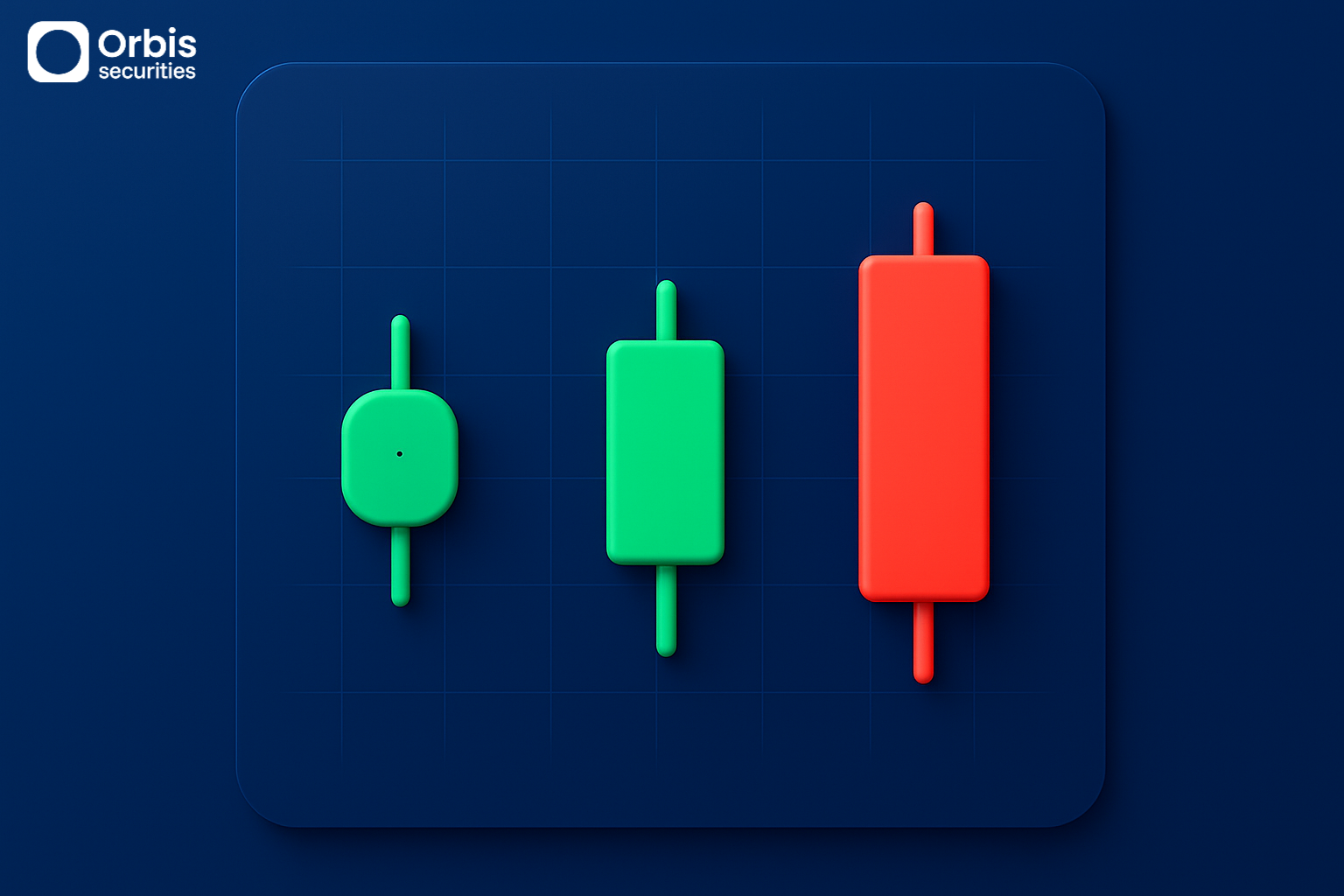
A candlestick summarizes the open, high, low, and close prices within a specific time period into a single visual form.

The area between the open and close is called the body, which allows traders to quickly identify whether the price moved up or down.

If the close is higher than the open, it indicates a bullish move;
if the close is lower, it indicates a bearish move.

The lines extending above and below the body are called wicks (or shadows).
They show how far the price moved during that period and help estimate the strength of buying and selling pressure based on their length.

Ultimately, a single candlestick is not just price data—it is a condensed representation of the balance of forces in the market during that time.


🔹 What Candlestick Patterns Represent

Individual candlesticks carry meaning on their own, but they become more significant when interpreted within their context and trend.

For example, when a candlestick closes with the open and close at nearly the same level, it reflects a balance between buyers and sellers, indicating market indecision.

This type of structure can signal that the current trend is weakening.

If a candlestick with a long lower wick appears during a downtrend, it suggests that strong selling pressure was present but ultimately overpowered by buyers pushing the price higher.

This can indicate weakening bearish pressure and may signal a potential rebound.

Conversely, if a similar pattern appears at the top of an uptrend, it may suggest that selling pressure is increasing.

While the price may appear to continue rising, the internal balance of power is already shifting.


🔹 Reversal Signals from Multiple Candles
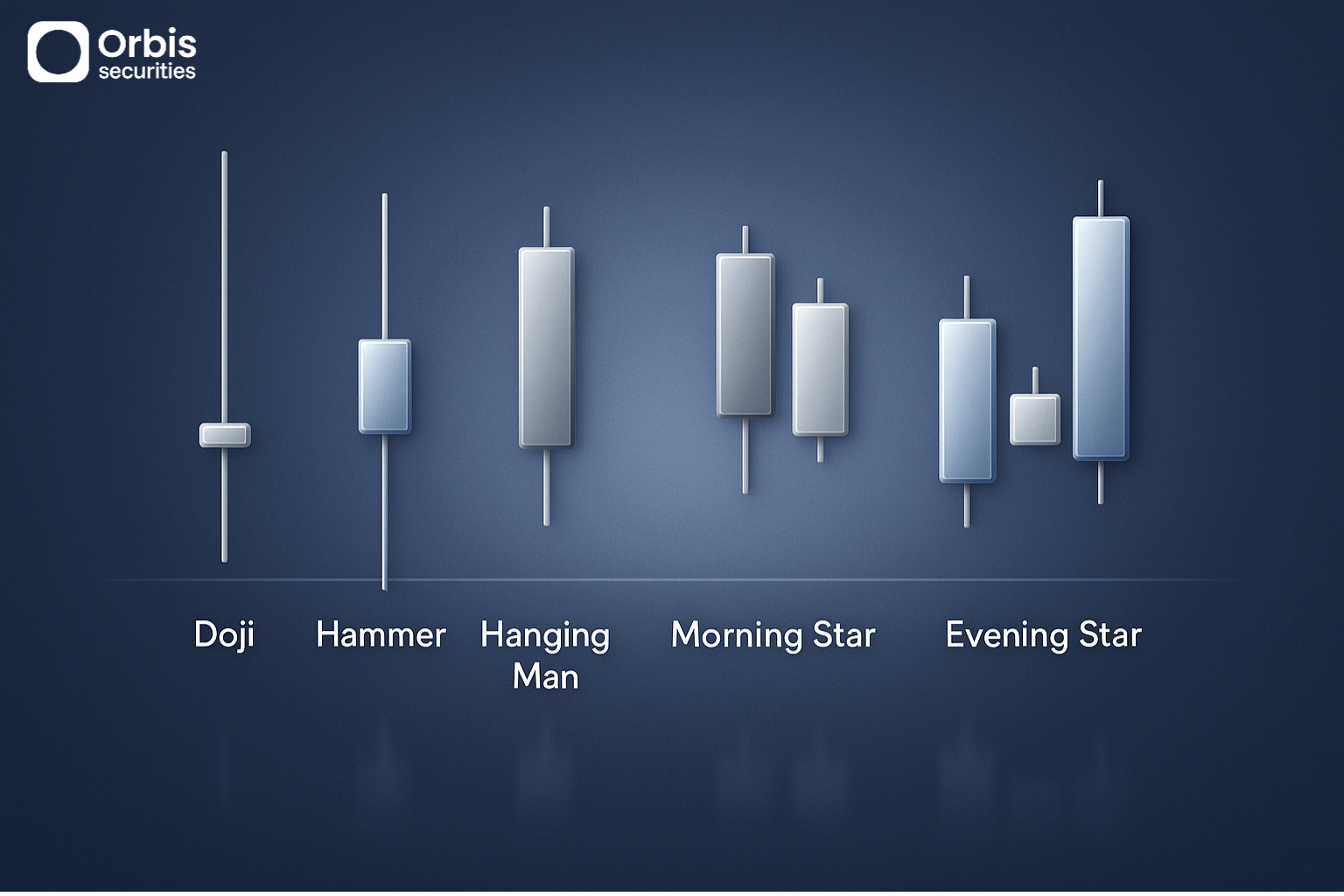
image.png

Candlesticks carry meaning individually, but when combined, they form clearer patterns.

For example, after a downtrend, a short period of consolidation followed by a strong bullish candle often indicates a shift in control from sellers to buyers—this is a classic reversal pattern.

On the other hand, after an uptrend, if the market pauses briefly and then forms a strong bearish candle, it can signal that the uptrend has ended and selling pressure is taking control.

These patterns represent not just price movement, but a step-by-step transition in market sentiment.


🔹 Key Principles for Interpreting Candles

Candlestick patterns should not be judged by shape alone—they must always be interpreted within context.

The same pattern can have completely different meanings depending on whether it appears at the top of an uptrend or the bottom of a downtrend.

It is also important to confirm patterns with trading volume.
If volume increases when a pattern forms, it suggests that real market participation is supporting the move, increasing its reliability.

Conversely, if volume does not support the pattern, it may simply reflect short-term volatility rather than a meaningful signal.​