Orbis Securities Logo
Orbis
Trading
Markets
Trading Platforms
Partnership
Customer Service
LoginSign Up

© 2025 Orbis Securities

Legal Information

This website is owned and operated by Orbis Securities (Pty) Ltd, a Limited Liability Company incorporated under the laws of South Africa, with registration number 2024/224812/07 and registered office address at 18 Cavendish Road, Claremont, Cape Town, Western Cape 7708, South Africa. Orbis Securities (Pty) Ltd is regulated by the Financial Sector Conduct Authority (FSCA) of South Africa with regulatory number FSP 54619.

The physical office address at Office 218, 50 Long Street, Cape Town, 8001, South Africa.

Regional Restriction

Orbis Securities (Pty) Ltd does not provide services to individuals of U.S. nationality, residents or any persons residing in jurisdictions identified as restricted or sanctioned by international regulatory authorities. Restricted countries and sanctioned jurisdictions include Afghanistan, Belarus, Cuba, Iran, Iraq, North Korea, Libya, Russia, Somalia, Syria, Ukraine, Yemen. This list is non-exhaustive and may be updated from time to time to comply with evolving international laws and regulations. Information in this website and services also not use by any person in any country or jurisdiction where such distribution or use would be contrary and deemed unlawful to local law or regulation.

Risk Warnings

Trading Derivatives carries a high level of risk to your capital, and you should only trade with money you can afford to lose. Trading Derivatives may not be suitable for all investors, so please ensure that you fully understand the risks involved and seek independent advice if necessary. For further assistance, please contact our Customer Support Team: support@orbissecurities.com or contact us at ‪+27 10 288 2018‬.

Orbis

  • About Orbis
  • Why Orbis?
  • Licenses & Regulation
  • Legal Documents

Trading

  • Account Types
  • Trading Server
  • Deposit
  • Withdrawal
  • Trading Conditions
  • Spreads
  • Swap
  • Margin & Leverage
  • Dynamic Leverage
  • Market Calendars
  • Trading Hours
  • US Earnings
  • AU Earnings

Markets

  • Forex CFDs
  • Commodity CFDs
  • Index CFDs
  • Index CFD Dividends
  • Cryptocurrency CFDs
  • Share CFDs
  • Share CFD Margins
  • Contract Specifications

Trading Platforms

  • MetaTrader 4
  • MetaTrader 5

Partnership

  • Partnership Overview
  • Partnership Benefits

Customer Service

  • Notice
  • Help & Support
  • Account Opening Guide
  • MT4 User Guide
  • MT5 User Guide
  • Economic Calendar
  • Trading Education

© 2025 Orbis Securities

Legal Information

This website is owned and operated by Orbis Securities (Pty) Ltd, a Limited Liability Company incorporated under the laws of South Africa, with registration number 2024/224812/07 and registered office address at 18 Cavendish Road, Claremont, Cape Town, Western Cape 7708, South Africa. Orbis Securities (Pty) Ltd is regulated by the Financial Sector Conduct Authority (FSCA) of South Africa with regulatory number FSP 54619.

The physical office address at Office 218, 50 Long Street, Cape Town, 8001, South Africa.

Regional Restriction

Orbis Securities (Pty) Ltd does not provide services to individuals of U.S. nationality, residents or any persons residing in jurisdictions identified as restricted or sanctioned by international regulatory authorities. Restricted countries and sanctioned jurisdictions include Afghanistan, Belarus, Cuba, Iran, Iraq, North Korea, Libya, Russia, Somalia, Syria, Ukraine, Yemen. This list is non-exhaustive and may be updated from time to time to comply with evolving international laws and regulations. Information in this website and services also not use by any person in any country or jurisdiction where such distribution or use would be contrary and deemed unlawful to local law or regulation.

Risk Warnings

Trading Derivatives carries a high level of risk to your capital, and you should only trade with money you can afford to lose. Trading Derivatives may not be suitable for all investors, so please ensure that you fully understand the risks involved and seek independent advice if necessary. For further assistance, please contact our Customer Support Team: support@orbissecurities.com or contact us at ‪+27 10 288 2018‬.

>>>Using Bollinger Bands to Navigate Volatility

Using Bollinger Bands to Navigate Volatility

Learn how to identify entry timing through band contraction and expansion.

April 17, 2026
image.png

Price does not move in a straight line—it expands and contracts in cycles.
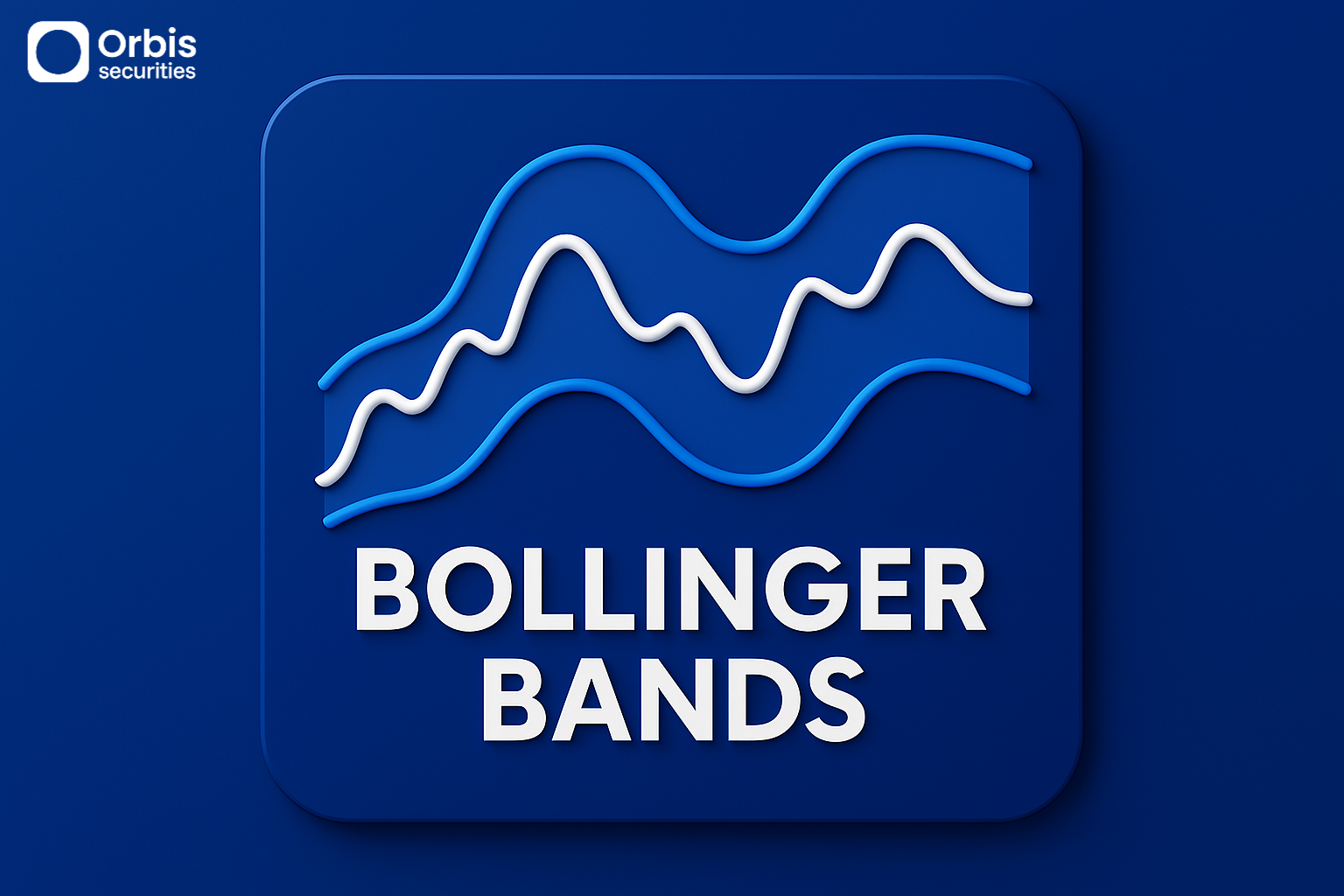
One of the most widely used indicators that visually represents this rhythm of volatility is the Bollinger Band.

Bollinger Bands are not just lines showing price range; they are a tool that allows traders to read both market energy and volatility levels at the same time.
When the bands narrow, price movement may appear to pause, but beneath the surface, the market is often preparing for a new directional move.
Conversely, when the bands widen, it typically reflects an already established trend that is rapidly expanding.


🔹 Structure of Bollinger Bands

Bollinger Bands consist of a middle line with upper and lower bands that represent the range of volatility.

The middle line is usually a 20-period simple moving average (SMA), while the upper and lower bands are calculated by adding and subtracting standard deviation from this average.

Since standard deviation measures how far price moves away from its average, higher volatility causes the bands to widen, while lower volatility leads them to contract.

Thanks to this structure, Bollinger Bands not only show trend direction but also the magnitude of price movement.


🔹 What Band Contraction and Expansion Mean

When the bands narrow, it indicates a period of low volatility.
Price moves within a tight range without establishing a clear direction—this phase can be seen as a buildup of energy.

Once volume increases or a catalyst appears, this stored energy often releases in one direction, leading to a significant price movement.

On the other hand, when the bands expand rapidly, it signals that volatility has increased and a trend is actively developing.
During these phases, price often moves strongly in one direction, and the widening bands visually reflect the strength of that trend.


🔹 Relationship Between Price and the Bands

Bollinger Bands statistically represent the range in which price spends most of its time.

When price approaches the upper band, it suggests stronger buying pressure, while movement toward the lower band indicates stronger selling pressure.

When price moves outside the bands, it represents a relatively rare situation, often indicating an extreme move in the short term.

There are two possible interpretations in such cases.
One is that a strong trend is beginning and the movement will continue in that direction.
The other is that the move is excessive and price will revert back toward the mean.

In strong uptrends, price may ride along the upper band, which does not necessarily indicate overbought conditions, but rather sustained buying pressure.

Conversely, when price breaks outside the band and then returns inside, it may signal that the extreme condition is easing and a reversal could occur.


🔹 How to Use Volatility Strategically

image.png

Bollinger Bands are most effective when used as a framework for understanding market conditions rather than as a single entry signal.

During periods of low volatility, it is often best to wait until a clear direction emerges.
Once the bands begin to expand and price starts moving in a specific direction, traders commonly follow that momentum.

Additionally, after price becomes heavily skewed in one direction, it is important to consider the possibility of a pullback.
This approach allows traders to take advantage of the market’s tendency to return to equilibrium after periods of extreme movement.​