Orbis Securities Logo
Orbis
Trading
Markets
Trading Platforms
Partnership
Customer Service
LoginSign Up

© 2025 Orbis Securities

Legal Information

This website is owned and operated by Orbis Securities (Pty) Ltd, a Limited Liability Company incorporated under the laws of South Africa, with registration number 2024/224812/07 and registered office address at 18 Cavendish Road, Claremont, Cape Town, Western Cape 7708, South Africa. Orbis Securities (Pty) Ltd is regulated by the Financial Sector Conduct Authority (FSCA) of South Africa with regulatory number FSP 54619.

The physical office address at Office 218, 50 Long Street, Cape Town, 8001, South Africa.

Regional Restriction

Orbis Securities (Pty) Ltd does not provide services to individuals of U.S. nationality, residents or any persons residing in jurisdictions identified as restricted or sanctioned by international regulatory authorities. Restricted countries and sanctioned jurisdictions include Afghanistan, Belarus, Cuba, Iran, Iraq, North Korea, Libya, Russia, Somalia, Syria, Ukraine, Yemen. This list is non-exhaustive and may be updated from time to time to comply with evolving international laws and regulations. Information in this website and services also not use by any person in any country or jurisdiction where such distribution or use would be contrary and deemed unlawful to local law or regulation.

Risk Warnings

Trading Derivatives carries a high level of risk to your capital, and you should only trade with money you can afford to lose. Trading Derivatives may not be suitable for all investors, so please ensure that you fully understand the risks involved and seek independent advice if necessary. For further assistance, please contact our Customer Support Team: support@orbissecurities.com or contact us at ‪+27 10 288 2018‬.

Orbis

  • About Orbis
  • Why Orbis?
  • Licenses & Regulation
  • Legal Documents

Trading

  • Account Types
  • Trading Server
  • Deposit
  • Withdrawal
  • Trading Conditions
  • Spreads
  • Swap
  • Margin & Leverage
  • Dynamic Leverage
  • Market Calendars
  • Trading Hours
  • US Earnings
  • AU Earnings

Markets

  • Forex CFDs
  • Commodity CFDs
  • Index CFDs
  • Index CFD Dividends
  • Cryptocurrency CFDs
  • Share CFDs
  • Share CFD Margins
  • Contract Specifications

Trading Platforms

  • MetaTrader 4
  • MetaTrader 5

Partnership

  • Partnership Overview
  • Partnership Benefits

Customer Service

  • Notice
  • Help & Support
  • Account Opening Guide
  • MT4 User Guide
  • MT5 User Guide
  • Economic Calendar
  • Trading Education

© 2025 Orbis Securities

Legal Information

This website is owned and operated by Orbis Securities (Pty) Ltd, a Limited Liability Company incorporated under the laws of South Africa, with registration number 2024/224812/07 and registered office address at 18 Cavendish Road, Claremont, Cape Town, Western Cape 7708, South Africa. Orbis Securities (Pty) Ltd is regulated by the Financial Sector Conduct Authority (FSCA) of South Africa with regulatory number FSP 54619.

The physical office address at Office 218, 50 Long Street, Cape Town, 8001, South Africa.

Regional Restriction

Orbis Securities (Pty) Ltd does not provide services to individuals of U.S. nationality, residents or any persons residing in jurisdictions identified as restricted or sanctioned by international regulatory authorities. Restricted countries and sanctioned jurisdictions include Afghanistan, Belarus, Cuba, Iran, Iraq, North Korea, Libya, Russia, Somalia, Syria, Ukraine, Yemen. This list is non-exhaustive and may be updated from time to time to comply with evolving international laws and regulations. Information in this website and services also not use by any person in any country or jurisdiction where such distribution or use would be contrary and deemed unlawful to local law or regulation.

Risk Warnings

Trading Derivatives carries a high level of risk to your capital, and you should only trade with money you can afford to lose. Trading Derivatives may not be suitable for all investors, so please ensure that you fully understand the risks involved and seek independent advice if necessary. For further assistance, please contact our Customer Support Team: support@orbissecurities.com or contact us at ‪+27 10 288 2018‬.

>>>Interpreting CPI & PPI Releases + Practical Trading Examples

Interpreting CPI & PPI Releases + Practical Trading Examples

Using chart movements as examples of how markets react to inflation data.

April 17, 2026
image.png

Inflation indicators are key variables that shape the direction of global financial markets.
In particular, the Consumer Price Index (CPI) and Producer Price Index (PPI) serve as direct references for changes in the Federal Reserve’s policy direction, while also resetting valuation benchmarks across global assets.

Since major asset classes—such as interest rates, currencies, equities, and commodities—are ultimately revalued based on inflation levels, these indicators act not just as economic statistics but as precise signals that move the entire market.


🔹 What CPI and PPI Represent

CPI reflects changes in prices that consumers actually experience.
It is the closest measure to real-world inflation and is widely used by the market to assess consumption trends and economic conditions.

On the other hand, PPI measures price changes at the production stage, reflecting cost structures faced by businesses.
For this reason, PPI often moves ahead of CPI, signaling potential changes in consumer prices.

Markets also focus not only on the headline number but on its composition.
Core inflation, which excludes energy and food, is used to assess structural inflation, while headline inflation reflects overall consumer experience.

Ultimately, what matters is not a single number, but the direction of inflation and how that trend will influence policy decisions.


🔹 Impact of Inflation on Asset Markets

When inflation comes in higher than expected, the market first reflects the increased likelihood of rate hikes.
In this process, the U.S. dollar tends to strengthen, while assets like gold often weaken due to rising real interest rate pressure.

The stock market reacts more complexly.
Rising inflation increases corporate costs and reinforces tightening policies, putting downward pressure on valuations.

Conversely, when inflation shows signs of slowing, expectations of rate cuts emerge, often creating positive momentum in equities and commodities.

In this way, inflation indicators do more than show price levels—they trigger a chain reaction across all asset classes through interest rates and capital flows.


🔹 How the Market Prepares Before the Release

Before CPI and PPI releases, the market often begins to form a directional bias.
Investors adjust their positions based on forecasts, while bond yields and the dollar reflect prevailing expectations.

Since PPI is released before CPI, it serves as an early signal for how producer price trends may influence consumer inflation.

During this period, volatility tends to decrease as the market enters a “waiting phase.”

Liquidity may thin out and trading conditions can become unstable, making it more important to observe rather than force trades.


🔹 How the Market Moves After the Release
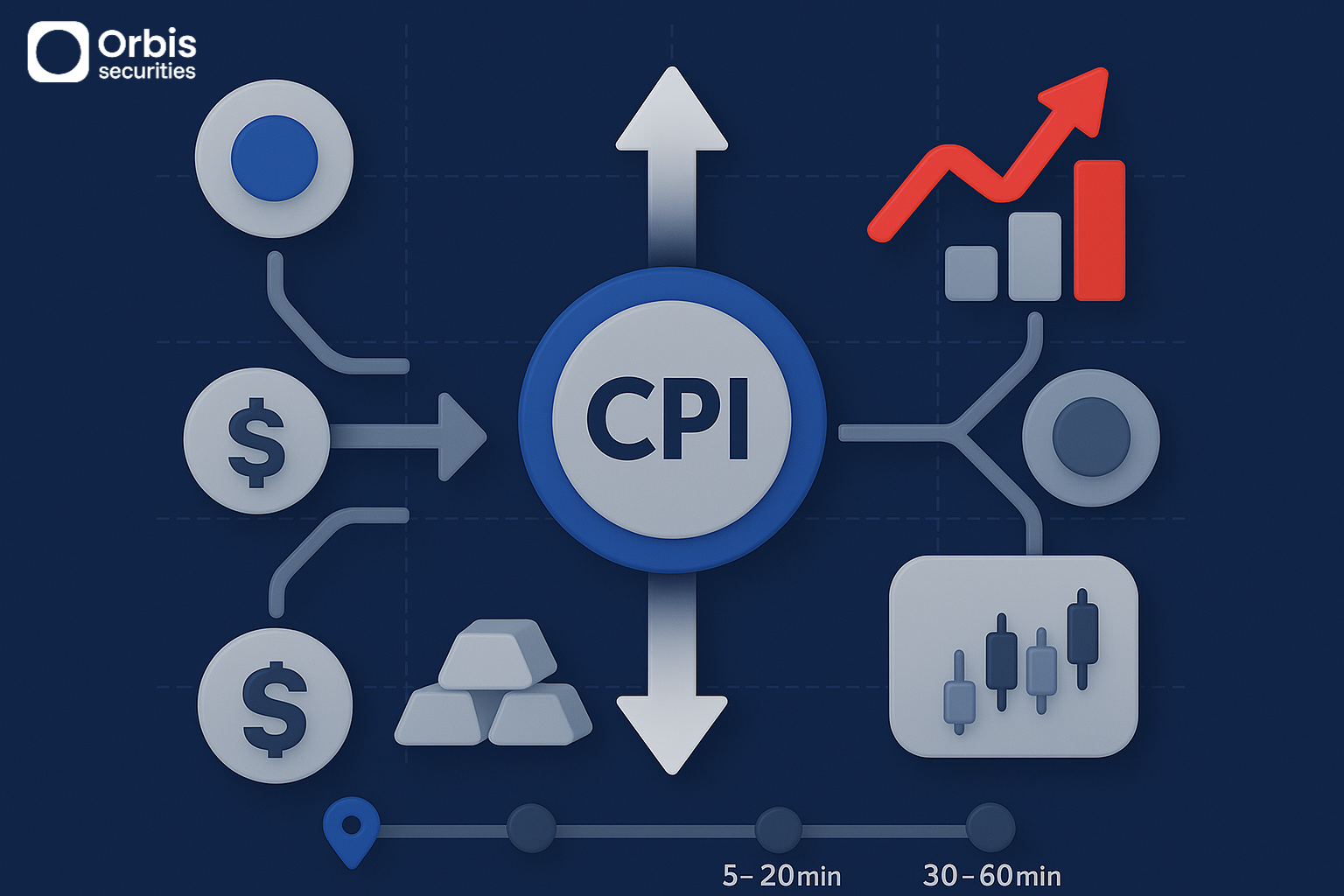
image.png

At the moment of release, the market reacts extremely quickly.
However, this initial movement is often driven by the headline number alone, making direction unstable.

As time passes, the market begins to reinterpret the data in detail.

Core inflation, category breakdowns, and prior trends are incorporated, gradually forming a more realistic direction.

Eventually, correlations between interest rates, the dollar, and equities strengthen, leading to either a sustained trend or a complete reversal of the initial reaction.

In the end, what matters is not the immediate reaction, but how the market interprets the data and settles into a direction.


🔹 How to Respond in High-Volatility Conditions

During inflation data releases, liquidity often decreases and spreads widen, causing trading conditions to shift rapidly.
Even small price movements can result in significant gains or losses.

For this reason, a more conservative approach is necessary compared to normal conditions.

In particular, the short period right before and immediately after the release is dominated by noise rather than clear direction.
Avoiding this phase and entering once the market stabilizes often leads to more consistent results.​