U.S. employment data is one of the most influential events in the global financial market.
In particular, the Non-Farm Payrolls (NFP), released on the first Friday of each month, affects almost all asset classes—including the dollar, gold, stock indices, and commodities—while significantly increasing short-term volatility.
At times, this single report can reset the market direction for an entire month, making it a critical event that traders must monitor.
🔹 What NFP Represents
NFP measures the change in the number of employed people in the U.S., excluding the agricultural sector, making it one of the most direct indicators of the economy’s “current strength.”
Since employment is closely tied to consumption—and consumption drives economic growth—the market uses this data to assess whether the economy is expanding.
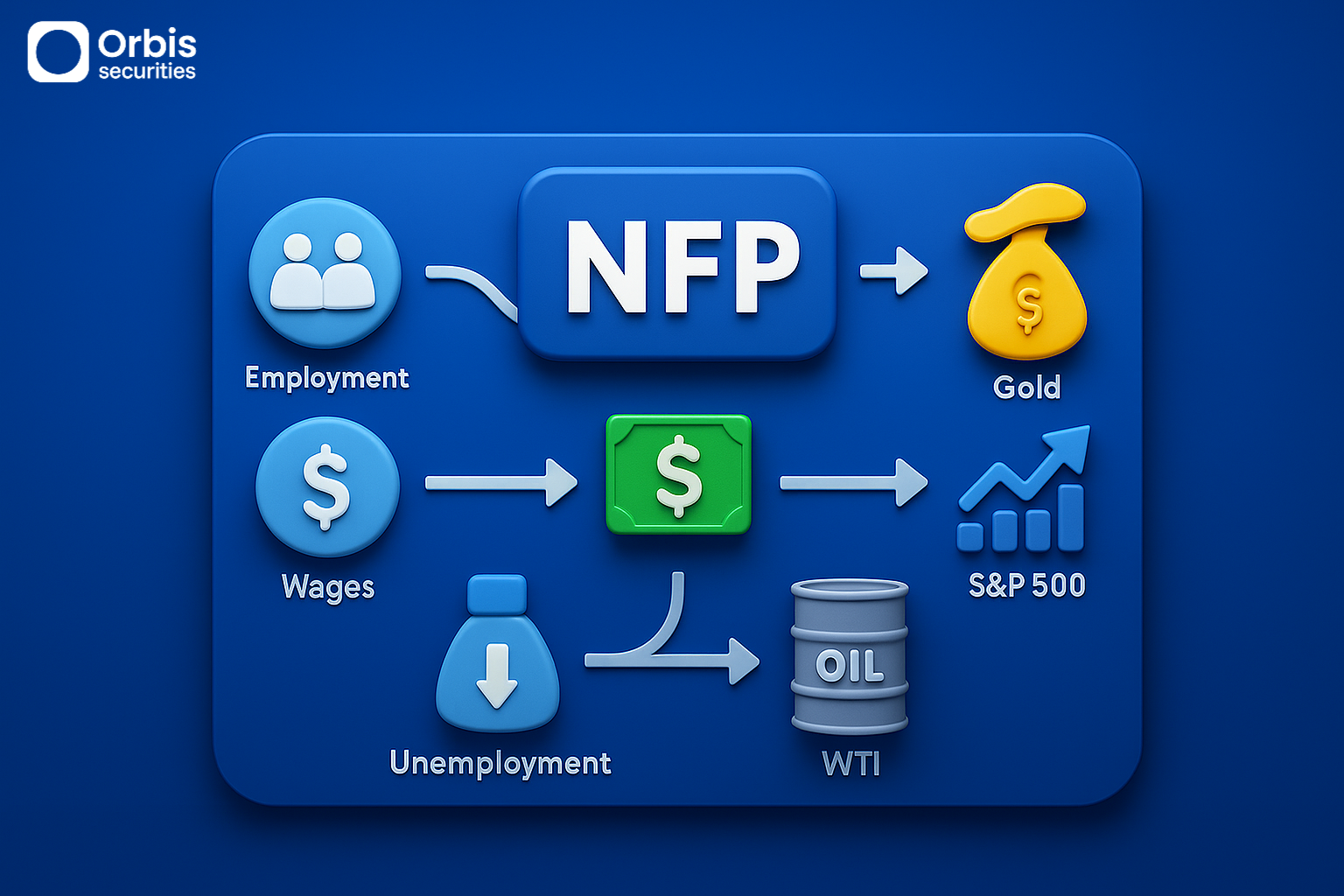
This report does not only include employment numbers but also releases the unemployment rate and average wages, meaning all three components influence market interpretation.
Most importantly, it’s not the absolute number that matters, but how much it deviates from expectations.
The same result can be interpreted positively or negatively depending on whether it exceeds or falls short of market forecasts, and price reacts accordingly.
🔹 How NFP Affects the Market
If employment comes in stronger than expected, it signals a resilient economy, increasing the likelihood of interest rate hikes and often strengthening the U.S. dollar.
Conversely, weaker-than-expected data raises concerns about economic slowdown but may also increase expectations of rate cuts, leading to dollar weakness.
These changes quickly spread across other asset classes.
When the dollar strengthens, gold tends to weaken, and when the dollar weakens, gold often rises.
The stock market reacts more complexly.
Strong employment data can create mixed reactions due to both economic optimism and interest rate concerns, while weak data may trigger short-term rebounds driven by expectations of monetary easing.
Ultimately, the market moves by balancing “economic strength” and “interest rate direction.”
🔹 Market Positioning Before the Release
Before the NFP release, the market often begins forming expectations and positioning in advance.
Traders use leading indicators to anticipate the outcome and adjust their positions accordingly.
For example, data such as private employment reports or unemployment claims help the market estimate the upcoming NFP result.
At the same time, movements in bond yields and the U.S. dollar provide key clues.
If yields are rising, it often suggests the market expects strong employment data.
During this period, volatility may actually decrease as the market enters a “waiting mode,” and spreads may temporarily widen.
🔹 How the Market Moves After the Release
Once NFP is released, the market reacts extremely fast and aggressively.
This initial movement is largely driven by algorithms and ultra-short-term trading, making it difficult to interpret or predict.
After a few minutes, the market begins to reassess the data in more detail.
Not only the headline employment number but also wage growth and unemployment rate are considered, gradually forming a clearer direction.
During this process, initial spikes and drops stabilize into a more realistic trend.
As time passes, correlations between assets such as the dollar, gold, and equities strengthen, either developing into a clear trend or completely reversing the initial move.
Ultimately, what matters is not the first reaction, but how the market settles afterward.
🔹 Trading Approach
NFP is less about predicting direction and more about utilizing volatility.
Rather than entering immediately after the release, a more stable approach is to wait until the market has processed the data and then follow the emerging trend.
A common strategy is to first identify the direction of the U.S. dollar, and then look for opportunities in correlated assets such as gold or stock indices.
The key is understanding how market expectations differ from the actual results.
🔹 Importance of Risk Management
During NFP releases, liquidity can drop sharply and spreads often widen, making trading conditions more unstable than usual.
Even small price movements can lead to significant losses.
For this reason, reducing position size or even staying out of the market can be a valid strategy.
In particular, the short period right before and immediately after the release is dominated by “noise” rather than clear direction.
Simply avoiding this phase can significantly reduce unnecessary losses.