Orbis Securities Logo
Orbis
Trading
Markets
Trading Platforms
Partnership
Customer Service
LoginSign Up

© 2025 Orbis Securities

Legal Information

This website is owned and operated by Orbis Securities (Pty) Ltd, a Limited Liability Company incorporated under the laws of South Africa, with registration number 2024/224812/07 and registered office address at 18 Cavendish Road, Claremont, Cape Town, Western Cape 7708, South Africa. Orbis Securities (Pty) Ltd is regulated by the Financial Sector Conduct Authority (FSCA) of South Africa with regulatory number FSP 54619.

The physical office address at Office 218, 50 Long Street, Cape Town, 8001, South Africa.

Regional Restriction

Orbis Securities (Pty) Ltd does not provide services to individuals of U.S. nationality, residents or any persons residing in jurisdictions identified as restricted or sanctioned by international regulatory authorities. Restricted countries and sanctioned jurisdictions include Afghanistan, Belarus, Cuba, Iran, Iraq, North Korea, Libya, Russia, Somalia, Syria, Ukraine, Yemen. This list is non-exhaustive and may be updated from time to time to comply with evolving international laws and regulations. Information in this website and services also not use by any person in any country or jurisdiction where such distribution or use would be contrary and deemed unlawful to local law or regulation.

Risk Warnings

Trading Derivatives carries a high level of risk to your capital, and you should only trade with money you can afford to lose. Trading Derivatives may not be suitable for all investors, so please ensure that you fully understand the risks involved and seek independent advice if necessary. For further assistance, please contact our Customer Support Team: support@orbissecurities.com or contact us at ‪+27 10 288 2018‬.

Orbis

  • About Orbis
  • Why Orbis?
  • Licenses & Regulation
  • Legal Documents

Trading

  • Account Types
  • Trading Server
  • Deposit
  • Withdrawal
  • Trading Conditions
  • Spreads
  • Swap
  • Margin & Leverage
  • Dynamic Leverage
  • Market Calendars
  • Trading Hours
  • US Earnings
  • AU Earnings

Markets

  • Forex CFDs
  • Commodity CFDs
  • Index CFDs
  • Index CFD Dividends
  • Cryptocurrency CFDs
  • Share CFDs
  • Share CFD Margins
  • Contract Specifications

Trading Platforms

  • MetaTrader 4
  • MetaTrader 5

Partnership

  • Partnership Overview
  • Partnership Benefits

Customer Service

  • Notice
  • Help & Support
  • Account Opening Guide
  • MT4 User Guide
  • MT5 User Guide
  • Economic Calendar
  • Trading Education

© 2025 Orbis Securities

Legal Information

This website is owned and operated by Orbis Securities (Pty) Ltd, a Limited Liability Company incorporated under the laws of South Africa, with registration number 2024/224812/07 and registered office address at 18 Cavendish Road, Claremont, Cape Town, Western Cape 7708, South Africa. Orbis Securities (Pty) Ltd is regulated by the Financial Sector Conduct Authority (FSCA) of South Africa with regulatory number FSP 54619.

The physical office address at Office 218, 50 Long Street, Cape Town, 8001, South Africa.

Regional Restriction

Orbis Securities (Pty) Ltd does not provide services to individuals of U.S. nationality, residents or any persons residing in jurisdictions identified as restricted or sanctioned by international regulatory authorities. Restricted countries and sanctioned jurisdictions include Afghanistan, Belarus, Cuba, Iran, Iraq, North Korea, Libya, Russia, Somalia, Syria, Ukraine, Yemen. This list is non-exhaustive and may be updated from time to time to comply with evolving international laws and regulations. Information in this website and services also not use by any person in any country or jurisdiction where such distribution or use would be contrary and deemed unlawful to local law or regulation.

Risk Warnings

Trading Derivatives carries a high level of risk to your capital, and you should only trade with money you can afford to lose. Trading Derivatives may not be suitable for all investors, so please ensure that you fully understand the risks involved and seek independent advice if necessary. For further assistance, please contact our Customer Support Team: support@orbissecurities.com or contact us at ‪+27 10 288 2018‬.

>>>Volatility in Currency Markets During Rate Hike Cycles

Volatility in Currency Markets During Rate Hike Cycles

Analyzing how forex and equity markets react during tightening cycles.

April 17, 2026
image.png

When interest rates rise, capital moves in search of higher returns.
This flow goes beyond a simple rate change and leads to a broader reallocation of currency values and asset prices.

For example, when the United States raises interest rates, dollar-denominated assets become more attractive, drawing global capital into the dollar.
As a result, the dollar strengthens, while emerging market currencies tend to weaken.

However, markets are more sensitive to the pace and expectations of rate changes than to the level itself.
A rate hike that is already anticipated has limited impact, whereas faster or more aggressive tightening than expected can sharply increase market volatility.


🔹 The Basic Mechanism of Rate Hikes

A rate hike ultimately reduces liquidity.
As borrowing costs rise, the investment environment becomes more conservative, affecting multiple asset classes in a chain reaction.

In the forex market, widening interest rate differentials drive capital toward higher-yielding currencies, rapidly shifting the balance of strength between currencies.
In the stock market, higher discount rates reduce company valuations, creating short-term downward pressure.

Assets like gold, which do not generate interest, tend to lose relative appeal as rates rise, and combined with a stronger dollar, often show weakness.

In the bond market, rising rates naturally lead to declining prices of existing bonds.
In this sense, a rate hike is not a single event but a structural shift that impacts multiple markets simultaneously.


🔹 Changes in the Forex Market
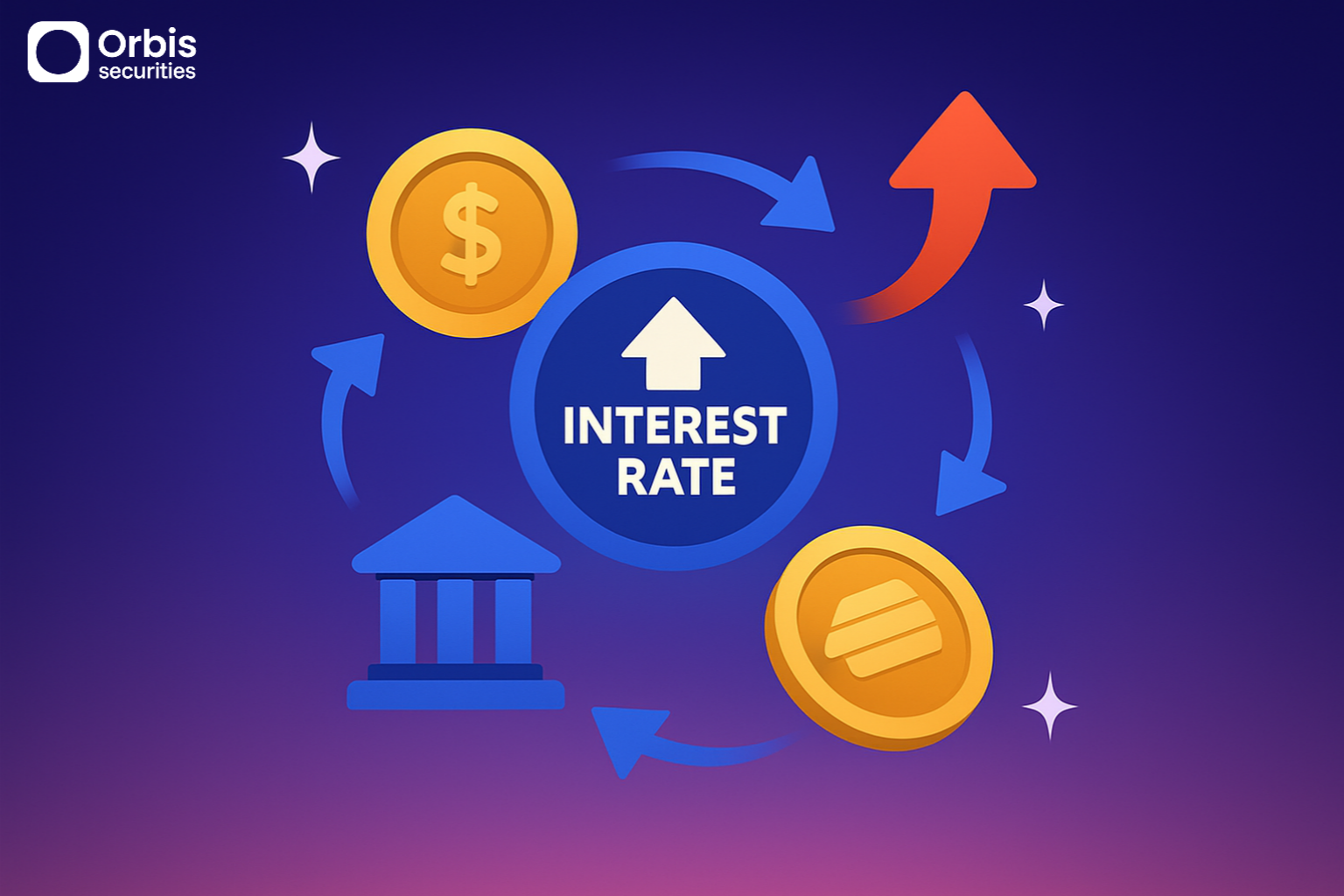
image.png

The forex market during a rate hike cycle cannot be explained simply by “a stronger dollar.”
Since central banks across countries move at different speeds and adopt different policies, relative currency strength is continuously adjusted.

For instance, if the U.S. raises rates faster than other countries, the widening rate gap reinforces dollar strength.
On the other hand, if Europe or other major economies tighten policy simultaneously, the dollar’s strength may be more limited.

Additionally, when inflation begins to slow, the market starts pricing in the end of rate hikes or a shift toward easing.
During this phase, previously strong currency trends can often reverse.

Ultimately, what matters in forex is not the absolute level of rates, but the direction, speed, and timing differences between countries.


🔹 How the Stock Market Reacts

Rate hikes generally act as a negative factor for the stock market.
Higher interest rates increase the discount rate applied to future earnings, putting downward pressure on valuations.

At the same time, reduced liquidity weakens investor sentiment, and growth-oriented markets are often more vulnerable to corrections.

However, the early phase of rate hikes can sometimes unfold differently.
The market may interpret this period as a normalization process following economic overheating, and even see it as a sign of economic strength, leading to short-term rebounds.

Ultimately, whether the tightening cycle is perceived as a shock or as a normalization process determines how the stock market reacts.


🔹 Key Factors Driving Volatility

The most important variable during a rate hike cycle is speed.

Markets are forward-looking, so they tend to react calmly to expected changes but become highly volatile when changes occur faster than anticipated.

In particular, during key events such as rate decisions, inflation data releases, and employment reports, volatility spikes as the gap between expectations and actual results becomes clear.

In these moments, rather than trying to predict direction, it is more important to understand and respond to the structure of expanding volatility itself.​